In this section, we will discuss and explore the foundational principles upon which tala e fonua can be understood:
1. The concept of fonua (the land and its people)
2. The tā-vā philosophy of space and time
3. The relationship between myth and history
After engaging with this material you will:
1. Be prepared to engage with various stories from the oral Tongan tradition.
2. Be able to reflect on your own relationships in space and time with greater depth.

Question 1: What is history and what can we learn from it? What is myth and what can we learn from it?
Question 2: Events happen in place and time, and often involve people and their actions. What kinds of context are relevant for understanding events?
The word fonua is an expansive term encompassing the land (broadly interpreted to also refer to the moana/ocean and langi/sky) and also the people and environment. Similar terms of shared origin (banua, hanua, vanua, fanua, fenua, and whenua) are used in this way across the moana/Oceania. [1]

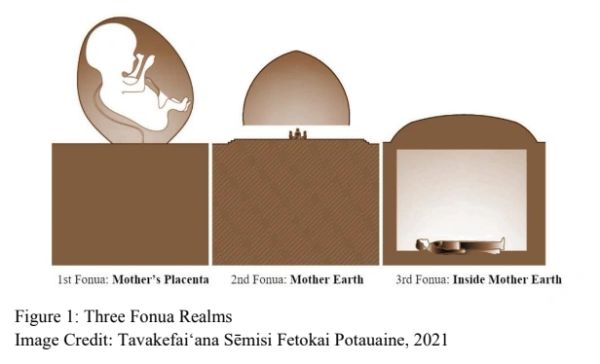
The term fonua expresses an ecological sense and awareness of the interconnectedness and interdependence between humans and the environment. At a deeper level, this ecological awareness is expressed in a cyclical way through the concept of the "three fonua"[2]:
1. The first fonua is the placenta of our human mother. It nourishes and grows us until we are born.
2. When we are born, the second fonua or "mother earth" nourishes, grows, and sustains us.
3. Finally, when we die, we are buried in the earth and placed into the tomb, or womb of mother earth.
In this sense the land and the people (fonua) become so tightly interwoven that they are in some sense indistinguishable from one another.
Because of this closely bound and inseparable relationship through which the people and the land are one, in the Tongan worldview, a person can be thought of as "bringing the land with them." Even when far away from one's land of origin, they are themselves an extension of the land.
As Sione Funaki summarizes it:
""Fonua has come to embody values held as being core to Tongan identity, as well as representing a connection between the Tongan people (wherever they might be in the world) and the physical place of Tonga itself (both the nation of Tonga and the villages/islands/clusters from which individuals claim origin)". This connection is constantly acknowledged, strengthened, called upon, and nurtured by Tongans not only in Tonga but throughout the diaspora, manifesting in a multiplicity of ways to show one’s deep affection for and pride in their Tongan heritage. As Francis mentioned, this may include specific island groups or villages that many Tongans in the diaspora have never even set foot in before. For these diasporic Tongans, being far removed physically from their island homes does not necessarily mean being far from the culture and the feeling of being Tongan. In many cases, the fonua-based identity can be accentuated further as Tongans who leave for foreign job and education opportunities continue to identify with their fonua roots and continually contribute to financially sustain the traditional livelihoods and cultural obligations of their relatives back in the motherland. Tongans, as with other Oceanians, live with a dichotomy of a deep connection to the land and oceans they originate from, and yet they are not bound by physical borders, moving out of Tonga but always bringing the fonua with them"
What land/fonua are you in reciprocal and interdependent relationship with? Explore the specific nature of this relationship: how are your existences interwoven?
Spend some time reflecting on and writing your own answer first before checking out the example answer and further ideas below
What specific practices and actions can you take to deepen your relationship with the fonua?
Spend some time reflecting on and writing your own answer first before checking out the example answer and further ideas below
Similarly to fonua and the concept of interrelationship that it encompasses, the concept of va (commonly translated as "space"), communicates a particular sense of relationality that underlies the Tongan worldview.
This sense appears also in the notion of tauhi va (literally translated as nurturing/tending to the space) which entails a proactive sense of responsibility for acting in ways that nurture harmony and reciprocity within the fabric of social and cultural relationships.
Finally, the contemporary framing of the ta-va theory of space-time holds va (space) and ta (time) as the two constituent components of the fabric of reality itself. Ta-va theory provides a critical lens through which we can view Tongan art and culture as forces which create and contextualize various intersections/relationships in space and time in a harmonious and meaning-making way.
"Vā is the space between, the between-ness, not empty space, not space that separates but space that relates, that holds separate entities and things together in the Unity-that-is-All, the space that is context, giving meaning to things. The meanings change as the relationships/the contexts change."
--Albert Wendt, Tatauing the Post-Colonial Body [4]
Va, translated literally, means space. But it is not an inert space or an empty vaccum. Rather, one can think of va as the vessel in which various things can be held in their varied relationships (at a particular point in time). The symmetries and tensions that arise between things due to their positioning within the va (in relation to each other) determine the overall state of harmony within the social context.
As Refiti says in his exposition on va [5], "vā is the potentiality of space". This highlights that va is not just about the relationships that are or that have been, but the space of potential symmetries and possible relationships that things could be arranged in based on their many facets and aspects.


This allows us to understand the practice of tauhi va- cultivating the space- as the intentional practice of shaping the actuality of those relationships, based on an understanding of the fullness of their potentiality and an aesthetic vision for a harmonious state that one wishes to create between them.
Tevita Ka'ili writes, "scholarship and writings on the Tongan notion of vā are mainly associated with tauhi vā (or tauhi vaha'a) – the art of creating and maintaining beautiful social relations... [T]auhi vaha'a may have originated from the tradition of keeping up good relations between ancient Tongans and their gods... In the area of social duties, tauhi vā is intricately connected to the performance of social duties."
Kaili further explores what makes social relations beautiful in the context of ta-va theory, writing: "For Tongans, relations of exchange that are symmetrical (potupotutatau) create mālie, beauty. In contrast, relations of exchange that are asymmetrical (potupotukehekehe) produce tāmaki, disharmony. [Figure to right]. The tā-vā theory of reality also argues that conflict is a permanent aspect of reality (Māhina 2007). Harmony and disharmony are both expressions of conflict. Specifically, harmony is a manifestation of conflicting relations that are symmetrical, and disharmony is an expression of conflicting relations that are asymmetrical."
To address ta-va theory, we must also speak about the Tongan notion of ta or time. A notable feature of the way that Tongans talk about time rhetorically is that the past is placed, not behind us, but in front of us. Ha'ofa writes, "In the Fijian and Tongan languages, the terms for past are gauna i lin and kuonga mu'a, respectively- gauna and kuonga meaning "time" or "age" or "era", and lin and mu'a meaning "front" or "ahead". When Fijian and Tongan preachers or orators point their fingers to the past... [they] point ahead. The conception of the past as ahead or in front of us is not mere linguistic construction. It has an actual historical basis in the documentation of our oral narratives on our landscapes." [7]
As Tongans, we keep the past always visible to us in our orientation towards time. But moreover, the Tongan sense of time is highly non-linear: it is cyclical and relationally defined. Ka'ili writes:
"In Tonga, people value the collectivistic and circular arrangement of tā and vā. In contrast, most people in the West privilege the arrangement of time and space in individualistic and linear manners. For example, in the West, people highly value their individualism and the linear marking of time from past (back) to future (forward). In Tonga, the aim of the collective arrangement of tā and vā is to bring all the numerous entities into harmony and beauty. For example, Tongans strive to create harmony and beauty within their large communal kin. Disharmony within a collective group is labeled as "tokolahi kovi," a collective group that is bad. Not only is tā-vā collective and communal but it is also arranged in a circular fashion. The intersection of time in space creates a circular arrangement of tā-vā. The Tongan art of lalava, decorative lashing, illustrates the Tongan ordering of time in space. In the art of lalava, the criss-crossing sennit cordages mark time (tā) in an intersecting, circular, and plural fashion."
A primary goal of Tongan culture and of the Tongan worldview is to arrange relations of time and space (and indeed to arrange the sense of time and space itself) in a way which produces beauty, harmony and social wellbeing.

TIMESTAMP 6:15-8:12: Listen to Okusitino Mahina, father of ta-va theory, discuss the art of Lalava as a metaphor for the act of creating varied and harmonious patterns in space and time through the intentional composition of opposing forces. These collective acts of composition become the culture and shared world.
What are ways in which tauhi va is practiced that you have witnessed within your own family and community?
Spend some time reflecting on and writing your own answer first before checking out the example answer and further ideas below
Different cultures arrange time and space in different ways through art, norms, language, and every day practices. Compare Tongan culture with another culture (preferably one that you have experienced living in) using the ta-va framework.
Spend some time reflecting on and writing your own answer first before checking out the example answer and further ideas below
Tala e fonua, or "telling of the land and its people", refers to the many stories from the ancient oral tradition that collectively tell the story of our history. But this history, and its encoding in these stories, must be read through the relational and ecological lens that we have discussed throughout this section. These stories reflect the va in which our shared reality is situated.
Myths can be used to justify, explain, or express a certain social or natural order. But importantly, they can also be used to create a certain kind of social and natural order. Specifically, myths and stories are one of the instruments through which ta and va can be culturally arranged: stories shape human action and thus their environment, which in turn drive the need for stories to explain the world around us. Thus, just as the people and the land are in cyclical relationship with each other, so are the stories of the people and the land an integral part of that cycle.
The ancient stories of the Tongan oral tradition rely highly on metaphor, or heliaki [8]. Heliaki reflects the symmetrical intertwining or intersection of two different things. This means that the use of metaphor within tala e fonua clarifies the relational and cultural landscape of meaning in which ancient Tongans understood their lives and histories.
This allows us to understand our history through these stories, though any attempt to unravel our history from these carefully woven stories into a linear and singular picture entirely misses the point of tala e fonua.
As an example of tala e fonua, the story below is given by Okusito Mahina [9], along with its general interpretation:
"The theme of the myth, as interpreted within the ecology-centered cultural and historical mode, is structured on the oppressive nature of the Tu'i Tonga imperial rule, symbolized by the winds (matangi) blowing from Tonga. The Tu'i Tonga's oppression was allegorized by Lekapai's confrontation with the winds, and the killing and eating of Sangone and the burying of its shell. This was then followed by a period of intense diplomacy and alliance formation through treaty, symbolized by Fasi'apule's visit and the exchange of fine mats."

"One day a Pulotu maiden, Hinahengi, landed in Tonga with her mother, Sangone, a turtle. But in Samoa, Lekapai had been troubled by the south winds destroying his yearly crops. Angered and frustrated by the mishaps, he set out in a canoe to find the winds, blowing from Tonga, and their source, and to wage war against them. On arrival in Tonga, Lekapai found Hinahengi sleeping and drying herself in the sun; her hair was tangled in nearby bushes. Undoing her hair, they cohabitated. Learning that the winds and their source were, respectively, Hinahengi's children and father, Lekapai confronted them. His attempt was fruitless, so he gave up. He then asked Hinahengi if he could return to Samoa. By agreeing, Hinahengi made way from Sangone to take him back. Hinahengi instructed Lekapai that, in dropping him in Samoa, she had to safely return home to Tonga, bringing back with her a bunch of coconuts and a coconut-leaf mat for her. None of the instructions, however, was honored. Instead, the people in Savai'i killed and ate Sangone, then buried her shell. Among the witnesses were Lo'au, in Samoa searching for the sun, and a young boy named Lafai. Lo'au put his hands on Lafai, saying that he, by growing stunted, was not to die until Sangone's shell was found. Since then his name was changed to Lafaipana.
On returning to Tonga, Lo'au reported the matter to Tu'i Tonga Tu'itatui. This prompted Tu'itatui to send his half-brother, Fasi'apule, to Samoa to recover the shell. When arriving in Samoa, they were received in a kava ceremony; Fasi'apule took charge of fava distribution and food allocation. Fasi'apule, by engaging in the task, made an esoteric speech. The aims were to locate Lafaipana, who, because of his age, would be the only person to understand them, and who, of course, knew of the shell. Symbolic fragments of his speech included "fufu mo hokohu" (lit. clap-and-fume, i.e. kava roots); "kau pongia 'i vao" (lit. a bunch of wilted-in-the-bush, i.e. a second-generation bunch of plantains); lou tangia mo kohi (lit. leaves of cry-and-parrot, i.e. young taro leaves); "kapahau ta-tangi" (lit. wings-of-high-pitch, i.e. a wild chicken), and "ngulungulu mo tokoto" (lit. grunt-and-lie-down, i.e. a huge pig). These items were brought as fono for the ceremony.
The Samoans were initially troubled each time Fasi'apule made a "kisu kava" (kava riddle), with each one skillfully interpreted. Lafaipana, who explained them, was identified. He took the Tongans to the burial site, where they exhumed Sangone's shell. Having found the shell, Lafaipana then collapsed and died. Fasi'apule and his party afterward returned to Tonga, taking with them the shell and the two fine mats, Hau-'o-Momo and Laumata'o-Fainga'a, given by the Samoan chiefs for presentation to the Tu'i Tonga."
Where do you see concepts such as heliaki and tauhi va appear in the Sangone story above? What are some deeper layers of interpretation to the story that you might speculate on within the ta-va framework?
Spend some time reflecting on and writing your own answer first before checking out the example answer and further ideas below. You may want to return to this story again when you've gained more references and knowledge throughout the course.
Follow the steps below to create a map of your spatial, ecological, and familial connections:
1. Family tree: Create your family tree that spans as many generations back as you can go.
2. Identifying place: Identify the geographic places (countries, islands, villiages) that your ancestors were from.
3. Drawing a map: Print or draw a map of Tonga, the Pacific and/or the world, and highlight the regions that you, your family, or your ancestors are connected to.
4. Mapping connections: Draw lines between the regions and label these lines with a name, words, or symbols that represent the people or events that caused that migration and connection between places.
5. Holding the unknown: Identify the areas in this map and tree that are still missing or ambiguous. Can you imagine stories of what might be in these gaps? Reflect on this ambiguity and see if any of it becomes filled in through your future learnings.
Plan, do, and then journal about at least 4 different acts of Tauhi Va. As you do, consider the following questions in guiding and reflecting:
1. What relationships and connections can I strengthen, tend, or re-frame to create greater harmony within my surrounding environment?
2. What acts can I do to strengthen these connections? What has kept me from doing this, and what are the ways in which I can re-frame conflicting cultural expectations or priorities to make these acts more common-place in my life?
3. What act or practice did I engage in, who else was involved, where and when did it happen? What did I feel before and after? What did I learn in practicing tauhi va in this instance?
[1] Potauaine, Semesi & Lotu, Hufanga-He-Ako-Moe. (2025). Fonua as fakafelavai (intersection) of ‘uta (land) and tahi (sea): Material arts of tufunga langafale (land-architecture or house-building) and fo‘uvaka (sea-architecture or boat-building). Interstices: Journal of Architecture and Related Arts. 24. 19-39. 10.24135/ijara.v24i24.822.
[2] Ka'ili, Tevita. (February 13, 2024). Fonua: Intersecting Cosmogony and Ecology, David O. McKay Lecture, BYU Hawaii.
[3] Funaki, Sione. (2025). Ko 'Emau Nofo pe 'eni ia 'o Pukepuke Fonua: We are Sitting Here, Tightly Holding onto the Land: Kava and Fonua in Ko'olauloa, Dissertation, University of Hawaii, Manoa.
[4] Wendt, Albert (April-October 1996) Tatauing the Post Colonial Body, Span 42-43: 15-29
[5] How the Tā-Vā theory of reality constructs a spatial exposition of Samoan architecture, Albert L. Refiti
[6] Ka'ili, Tevita. (2008). Tauhi Vā: Creating Beauty through the Art of Sociospatial Relations, Dissertation, University of Washington.
[7] Hau‘ofa, Epeli. (2020) ‘Epilogue Pasts to Remember’, in R. Borofsky (ed.) Remembrance of Pacific Pasts: An Invitation to Remake History. Honolulu, HI, USA: University of Hawai'i Press. Available at: https://doi.org/10.1515/9780824888015-040.
[8] Afuha‘amango and Ongo‘alupe Taumoepeau, “Heliaki: The Symbolic Depiction of Life and Living in Tonga,” in Traditional Knowledge and Wisdom: Themes from the Pacific Islands, ed. Samuel Lee (ICHCAP, 2014), 101, https://library.sprep.org/sites/default/files/traditional-knowledge-wisdom-themes-pacific-islands.pdf
[9] Calder, Alex & Lamb, Jonathan, 1945- & Orr, Bridget & David Nichol Smith Memorial Seminar 1993 : University of Auckland). (1999). Voyages and beaches : Pacific encounters, 1769-1840 / edited by Alex Calder, Jonathan Lamb, and Bridget Orr. Honolulu : University of Hawai'i Press
We use cookies to analyze website traffic and optimize your website experience. By accepting our use of cookies, your data will be aggregated with all other user data.